Die Crossmedia-Literaturkritikerin, Literaturwissenschaftlerin und Moderatorin Bozena Badura gilt u. a. als Expertin für deutschsprachige Erstlingswerke.
Ihre perfekte Spieltechnik und ihr künstlerischer Feinsinn haben Susanne Szambelan längst internationale Anerkennung eingebracht. Im Interview mit Porta Polonica spricht die Cellistin u. a. über ihre ...
Manchmal braucht es nur ein Werk, um sich als Künstler unsterblich zu machen. Jurek Becker ([1937]–1997) hat das mit seinem Roman „Jakob der Lügner“ geschafft.
Bascha Mika (*1954) gehört zu den polnischstämmigen Stimmen, die in der deutschen Medienbranche Gewicht besitzen. Im Laufe ihrer Karriere bekleidete sie zahlreiche Führungspositionen – und wurde somit...
Künstliche Intelligenz wird alle Bereiche unseres Lebens beeinflussen. Das gilt auch für die Sprache. Ein Unternehmen, das dabei ganz vorne mitmischt, ist DeepL. Dahinter steht ein polnischer Kopf: Ja...
There is no way of glossing over the statistics: there are over half a million homeless people living in Germany, thousands of whom are from Poland. There could be up to 5,000 homeless Poles in Berlin...
Es ist ein Lied, das untrennbar mit Deutschlands Schlagergeschichte verbunden ist, aber auch Schattenseiten hat. Mehrere Interpreten haben das tragische Lied ins Repertoire aufgenommen.
Around 3,100 forced labourers worked at Elektro- und Feinmechanische Industrie GmbH (ELFI), a hidden factory in the Hildesheim forest owned by Bosch. Later, the company was re-named Trillke-Werke GmbH...
In 2011, a slim volume was published that caused quite a stir in Germany. Sharp-eyed readers may already have raised an eyebrow: is the author’s name really Justyna Polanska?
Anna Tatarczyk’s works transport the observer into a world of colour, light, and form that at first sight look like a clear geometric structure. However, a closer look reveals the multi-layered dimens...
She inherited her love for discovering and portraying characters and stories from her family. Today she lives in the Kreuzberg district of Berlin, and has long spoken German better than Polish.
On 26 November 2024, the footballer Jan Furtok died of Alzheimer’s disease in his birthplace of Katowice, aged just 62. In Poland, Furtok is a legend. In Germany, he is particularly well remembered in...
Son of a well-to-do-family, party functionary, sports reporter. Konrad Glücksmann-Gruda (1915–2012) was a colourful personality who wanted to make the best of difficult situations.
In order to gain access to information, Halina Kłąb-Szwarc (1923–2002) transformed herself into a thoroughly German woman. Her major achievements include the localisation of important military facilit...
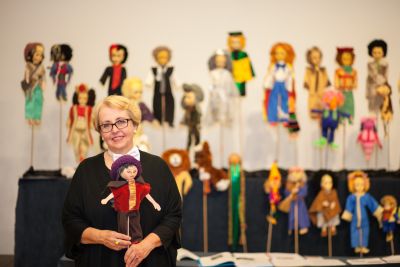
With her “Offene Augen” (“Open Eyes”) puppet theatre in Bielefeld, Maria Końska-Chmielecki (1954–2022) masterfully combined her passion for art with her career as a psychologist.
The author Mariusz Hoffmann spent his childhood in Zalesie, a small village where even then it felt as though time had stood still. His parents then decided to move to Germany in search of a better li...
Kurz vor dem Weihnachtsfest des Kriegsjahres 1942 wurde im nordpfälzischen Kerzenheim bei Kirchheimbolanden der polnische Zwangsarbeiter Leon Dudas erhängt, sein „Vergehen“ hatte einzig darin bestande...